A BizScout Report
The Great Business Handoff
The largest transfer of business ownership in history is underway. Where the businesses are, what they are worth, and how to buy before the market does.
August 2026 · 14 min read

Executive Summary
Every year, roughly half a million American small and midsize businesses exit the market. Only about 5% are sold. The rest mostly close their doors, including businesses that had real value and willing buyers who never found them. Over the next decade, that quiet failure collides with the largest ownership transfer in history: as many as 6 million boomer-owned businesses changing hands or shutting down, with more than 1 million viable candidates for sale worth up to $5 trillion.
The story most people tell about this wave is a story about sellers. This report tells the buyer’s version. The businesses are there. The market to reach them barely exists.
Even among the businesses that do sell, the majority change hands quietly, through accountants, advisers, and personal networks, before they ever appear on a public listing. The visible for-sale market shows a sliver of what is actually trading.
BizScout’s own marketplace data makes the pattern concrete9. Across the businesses actively for sale on the platform, the industry mix looks nothing like the retirement wave. Restaurants and bars, which churn and list constantly, are heavily overrepresented. The professional practices and skilled trades that carry the largest share of retiring owners, and the strongest buyer demand, are the scarcest things on the open market. What is easy to list and what is actually retiring are two different maps.
That gap is the opportunity. The retirement wave has abundant supply, but buyers lack a reliable way of sourcing it.
The buyers who win over the next 10 years will be the ones who see the widest field of businesses, the listed and the unlisted alike, size up the numbers quickly, and move with conviction. The listed market is where almost everyone starts, and it should be. It is also only part of the picture.
Section 1
The Wave
The demographic turnover is already underway. Roughly 10,000 Americans reach retirement age every day, and by 2030 the entire baby boomer generation will be 65 or older. The share of Americans of retirement age has climbed from 12% in 2005 to about 19% in 2025, and it is still rising.
A wave of baby boomer retirements is underway.
That wave lands with unusual force on business ownership, because boomers built and still hold a large share of the country’s businesses. More than half of privately held businesses with employees have an owner over 55, a share that has climbed steadily for two decades1,2. Yet only about half of owners have a succession plan of any kind, and fewer than a third have a documented one2,3.
How big is the wave? It depends on how you count. Working from Census data, Project Equity counts about 2.9 million employer businesses with owners over 55. Broader estimates that fold in sole proprietors put the number of boomer-owned businesses closer to 12 million4, though most of those are tiny and will close rather than sell. Looking forward, McKinsey projects about 6 million small and midsize businesses will change hands or close by 2035, up from about 4.5 million in the prior decade. The anchors differ, but every count lands at the same order of magnitude.
How big is the wave? It depends on how you count.
And these businesses carry real weight: small businesses make up 99.9% of American companies and employ close to half the private workforce, and the boomer-owned share of them supports about 32 million jobs, roughly one in six in the country2,1. This is the operating layer of the American economy, and it is turning over.
Of the millions of businesses in motion, McKinsey estimates that more than 1 million are viable candidates for sale, worth up to $5 trillion in enterprise value; broader analyses that count business assets more loosely put the total value in motion by 2030 closer to $10 trillion. For a buyer, the viable-for-sale number is the one that counts. It filters out the mom-and-pops that will simply shutter and leaves the pool worth pursuing: real, cash-flowing, transferable businesses a prepared buyer could actually acquire.
Section 2
The Bottleneck
In 2022, an estimated 510,000 small and midsize businesses exited the market. Of those exits, 92% happened through closure, 5% were completed as a sale, and 3% transferred to a new owner, often a family member5.
Most American small businesses end in a quiet shutdown rather than a sale.
These closures are a structural failure of the market, rather than a verdict on the businesses themselves. A meaningful share of these closures were avoidable. These companies had value. There was simply no functioning path to move them to a new owner.
Why does the path break down? Because the market for buying a business is fragmented and opaque in a way the market for starting one is not. There are incubators, accelerators, and endless playbooks for founding a company. There is almost no equivalent infrastructure for acquiring one. Buyers and sellers struggle to find each other. Financials are often incomplete. Brokers vary widely in quality and tend to chase larger deals. As a result, viable businesses stay hidden and prepared buyers cannot find them.
The pattern shows up in independent data. Fewer than 15% of these businesses are passed on to family, and about a third of owners over 50 report having a hard time finding a buyer at all1. Most small-business sales never run through a formal, visible process. Owners talk to their accountant, a trusted adviser, or someone they already know. If that does not produce a buyer, the business may never truly go to market. It just closes.
What a buyer can actually see is a sliver of what is actually exiting.
Under McKinsey’s ratios, only around 25,000 of the roughly half million businesses that exit each year are completed as sales, and most of those never run through a transparent, public process. The businesses that actually change hands are a small share of the businesses that exit, and the ones a buyer can see on any public listing are a small share of even that. The real market is mostly invisible. It is also overwhelmingly driven by retirement. Across the business-brokerage industry, retirement is consistently the single most common reason owners sell, and baby boomers now account for close to 60% of the owners bringing companies to market6.
When most transactions happen off-market, the buyer’s single largest edge is visibility. Seeing a business before it is listed, or when it would never have been listed at all, is worth more than any other advantage in the process. The retirement wave rewards sourcing above everything else.
Section 3
By Industry
The wave does not fall evenly across sectors. McKinsey projects the largest volumes of transitions in retail, accommodation and food services, professional services, and construction, the labor-intensive, locally embedded businesses that underpin daily life. Health care, manufacturing, and administrative services follow.
The enterprise value tells a different story than the volume. Nearly half of the value in play sits in capital- and labor-intensive industries such as manufacturing, mining, and utilities, where more than 60% of owners are already over 55 and about a quarter are over 655. These companies are harder to transfer because they depend on specialized equipment, technical knowledge, and working capital, which narrows the pool of qualified buyers. High value, hard to move.
What is retiring is not what is for sale
BizScout brings the live, for-sale market together in one place, so its active listings are a direct read on what buyers can actually see today. And the visible market does not match the wave.
Comparing each sector’s share of the retirement wave McKinsey projects against its share of what is currently listed on BizScout, across the seven sectors McKinsey breaks out:
What is easy to list and what is actually retiring are two different maps.
Two divergences stand out.
Accommodation and food services makes up about 42% of what is listed on BizScout, against roughly 17% of the wave5,9. Restaurants, bars, and cafes turn over constantly and list readily, so they crowd the open market far beyond their share of retiring owners.
Professional services runs the opposite way. It is about 17% of the wave and only about 5% of listings5,9. Accountants, law firms, engineering practices, and clinics retire in large numbers, but they almost never appear on a public marketplace. They transfer through partner buyouts and quiet, relationship-driven deals. Construction shows the same pattern in milder form, roughly 16% of the wave against about 11% of listings. Independent data points the same way: analyses of ownership by age find retirement-age owners concentrated in professional services, construction, and retail1, the very categories hardest to find on the open market.
Listings are the natural place to start. But the listed market, by its nature, can only ever show part of the wave. Pairing the marketplace with off-market sourcing covers the field. Either one alone leaves most of it unseen.
The trades prove the squeeze

Nowhere is the mismatch sharper than in the skilled trades. Demand for home services and essential trades, HVAC, plumbing, electrical, roofing, and pest control, has run well ahead of supply. Private equity alone acquired close to 800 HVAC, plumbing, and electrical companies between 2022 and the present7, and the combined HVAC and plumbing services market generates roughly $205 billion in annual revenue. Brokers in these categories report far more active buyers than available listings. Once again the bottleneck is finding the business, and pricing reflects that competition.
Across the business-brokerage industry, well-run Main Street companies valued between $1 million and $2 million have traded around 3.3 to 4.0 times earnings, and lower middle market firms have reached 5.3 to 6.5 times, among the strongest levels in a decade6. Clean books and durable cash flow command a premium, and buyers are increasingly metrics-driven.
Well-run businesses are commanding some of the strongest multiples in a decade.
The most owner-dependent businesses are the riskiest to inherit. A small manufacturer or specialty shop whose value lives in the founder’s head and relationships can lose that value the day the founder leaves. Volume is highest in the trades and services. Scrutiny matters most where the owner is the business.
Section 4
By Region
Geography splits into two very different markets.
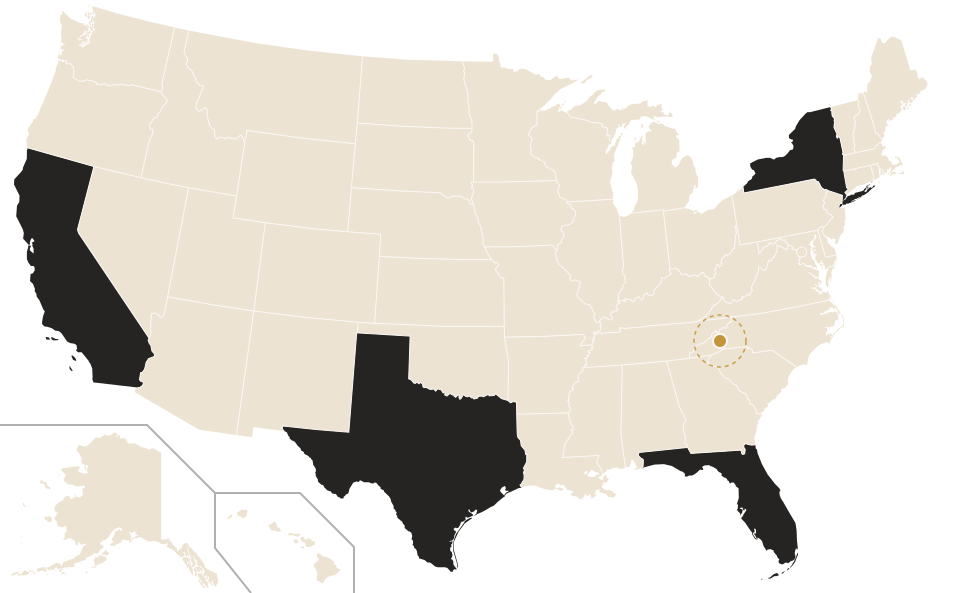
Most of the enterprise value sits in the largest state economies: California, Florida, New York, and Texas5. These are also where buyer competition is deepest, thanks to large populations, established business communities, and dense financing networks. If a buyer wants the most liquid market, that is where it is. So is the most competition for every deal.
The higher relative exposure, and often the lower competition, sits in smaller and rural states. Project Equity’s state-by-state analysis shows the boomer-owned business base makes up a larger share of the local economy in less-populous regions, where a single wave of retirements can put a meaningful slice of local jobs in question. Rural counties tend to have older owners, higher exit rates, and the thinnest pool of replacement buyers.
One region shows the concentration: western North Carolina.
For the economy, rural exposure is a risk, because a failed transition in a small town can permanently break a local economic ladder, and that exposure is far from evenly spread1. For an individual buyer, the same conditions read differently: more motivated sellers, less competition, and businesses that anchor their communities. The catch is that these are exactly the companies least likely to ever appear on a listing site. In thin rural markets, off-market sourcing is the only way in.
The deepest, most liquid markets are the most crowded. The least crowded markets are the hardest to see into. Either way, the buyer’s problem resolves to the same thing: visibility into businesses that are not publicly for sale.
Section 5
Who Is Buying, and the Opening

For the first time in memory, the country faces an oversupply of businesses for sale rather than a shortage. That is a genuine and rare condition. It creates room for a new generation of owners to step in. But demand is uneven, and it thins out in exactly the segment where most of the supply sits. Buyers fall into three broad types.
The supply sits exactly where that demand thins. Roughly 80% of projected exits are companies worth under $2 million5. This is the missing middle: businesses too large to sell on a handshake, too small to attract institutional buyers, and largely invisible to the market as a result.
The missing middle is where the supply is, and where the buyer infrastructure is weakest.
That mismatch is the opening. Whoever can reliably connect independent buyers to sub-$2 million businesses is serving the largest underserved segment of the entire transfer.
The handoff is already visible in the data. First-time buyers now account for about 46% of Main Street acquisitions, with serial entrepreneurs another 32%6. Buying a business has become a recognized path in its own right: the number of tracked search funds in the US and Canada has grown from around 20 in the mid-1990s to more than 800 by 2026, with new launches at or near record highs over the last three years and a long-run acquisition success rate near 60%8. A new generation of operators is stepping into a market still owned overwhelmingly by retiring boomers.
Buying a business has become a recognized path in its own right.
Nearly half of everyone who signs up goes on to search seriously. These buyers have the ambition and, increasingly, the capital. What they still need is a reliable way to find the businesses.
The capital is increasingly available. Financing rarely blocks deals in the core segment, and it keeps getting easier. SBA 7(a) acquisition lending reached $8.29 billion in the 2025 fiscal year, up about 35% year over year, across roughly 7,000 funded deals supporting close to 98,000 jobs2. The average acquisition loan rose to about $1.18 million, a sign that buyers are going after larger, more established businesses.
The combined SBA 7(a) and 504 borrowing cap was raised to $10 million, and the program introduced higher guarantees for manufacturers and trade-oriented borrowers. Acquisition loan default rates have historically stayed low. None of that erases the friction. Underwriting tightened in mid-2025, most lenders now want strong credit and a 10 to 20% equity injection, and SBA-financed deals typically price at 3 to 5 times earnings rather than the higher multiples private equity pays. But the headline holds: for a prepared buyer targeting a real, cash-flowing business, money is findable. The scarce input is the business.
There is also a cultural tailwind. A decade ago the ambitious default was to start something, ideally in tech. That default is shifting. Layoffs and automation have made a profitable, boring, essential business look less boring. Codie Sanchez, BizScout’s founder and CEO, has spent more than a decade making the case that owning a Main Street business, whether a plumbing company, a laundromat, or an HVAC operation, is one of the most reliable and overlooked paths to wealth in America. The market is finally catching up to that thesis.
“Extraordinary wealth comes from buying ordinary businesses that already work.”
Section 6
How to Catch the Wave
In a market where supply is abundant, capital is available, and most transactions happen off-market, the entire game is finding the right business, sizing it up, and closing it before anyone else does. Three stages, and the buyers who win are the ones with a system for each.
Stop searching. Start closing.
Private Client is white-glove deal support for buyers who have the capital and the conviction but not 20 hours a week to run the hunt. A dedicated acquisition partner with private equity and M&A experience works your pipeline across broker networks, off-market outreach, and proprietary BizScout deal flow, then hands you a short list of businesses already researched, financially analyzed, and matched to your criteria. You evaluate conclusions, not listings, and we stay with you through to close.
Schedule a Strategy SessionThis is what BizScout is built around, because it maps to where the real friction in this transfer actually lives. The goal is simple: turn the largest ownership transfer in history from something buyers watch into something they can act on.
The wave will crest with or without any individual buyer. The only open question is who is positioned to catch it.
Close
The Market Is Missing, Not the Businesses
The retirement wave is often framed as a looming loss: millions of businesses at risk, communities exposed, a generation of owners without a plan. That risk is real. But it exists for one reason, and the reason is fixable. Healthy businesses are shutting down for lack of a market to move them.
For a buyer, those are the most favorable conditions in a generation: abundant supply, available capital, and a market so inefficient that visibility alone is a durable advantage. The business you want exists. The work is finding it before the market does.
Sources
About This Report
This report synthesizes the most authoritative current research on the US small-business ownership transition. It draws on demographic and economic data from the US Small Business Administration and the nonprofit Project Equity, forward projections from the McKinsey Institute for Economic Mobility, buyer-side research from Stanford Graduate School of Business and the business-brokerage industry, federal lending data, and BizScout’s own marketplace data. Where estimates vary across sources, the report presents the range and anchors on the more conservative, defensible figures.
Ready to Catch the Wave?
The businesses are there. BizScout brings the for-sale market into one place, surfaces off-market and direct-to-owner deals, and helps you analyze the numbers so you can move with conviction.